












Bitzer showcases large-scale heat pump innovation at Chillventa
Germany – Bitzer is presenting new compressor technologies and solutions at Chillventa 2026, with a focus on large-scale heat pumps, data centre cooling, and natural refrigerants.
Exhibiting in Hall 1, Stand 303, under the theme ‘Shaping the Future with You’, the company says it is highlighting technologies designed to address industrial decarbonisation, increasing cooling demands and changing refrigerant requirements.
The developments include the new CSH2T compressors for high-temperature heat pumps, HELICOM CS60 screw compressor series for data centre applications, and expanded product ranges for CO₂, propane and ammonia systems.
High-temperature heat pumps for industrial decarbonisation
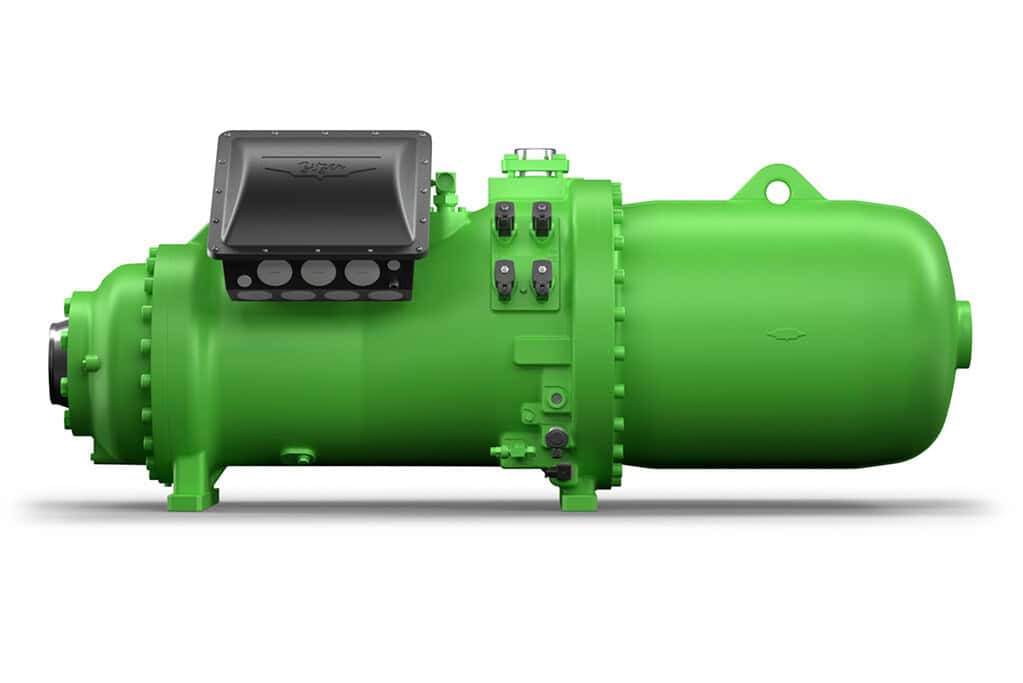
Bitze is focusing on the growing market for large-scale heat pumps, particularly applications involving industrial process heating, district heating and waste heat recovery. A central exhibit is the CSH2T compact screw compressor series, developed specifically for high-temperature heat pump applications.
The compressors enable fluid outlet temperatures of up to +120°C and offer heating capacities of approximately 1.1 MW per compressor. These operating characteristics make them suitable for industrial heating processes and larger district heating installations.
Bitzer is also working to extend the application range of its heat pump components to condensing temperatures above +140°C.
The company says its portfolio of compressors, heat exchangers and frequency inverters, supported by more than 50 years of heat pump application experience, is intended to help manufacturers and system designers address the technical challenges of high-capacity heating installations.
Responding to growing data centre cooling demands
The expansion of artificial intelligence (AI), high-performance computing and digital infrastructure is increasing cooling requirements across the data centre sector. Higher server rack power densities and associated heat loads are creating demand for cooling systems that combine energy efficiency, reliability and operational flexibility.
Bitzer is introducing its HELICOM CS60 screw compressor series to address these requirements. The technology supports cooling systems for the latest generation of AI chips, with supply temperatures of up to +45°C.
“With HELICOM, we are presenting one of the most significant developments in our screw compressor technology,” said Rainer Große-Kracht, Vice-Chairman of the Management Board and Chief Technology Officer.
The series supports established low-global warming potential (GWP) refrigerants and is designed for a range of operating conditions, including low-lift applications at reduced ambient temperatures.
Optimised rotor profiles and efficient full- and part-load operation are intended to help data centre operators achieve demanding power usage effectiveness (PUE) targets. An integrated IQ MODULE provides additional monitoring and control functionality to support system reliability.
Expanded natural refrigerant portfolio
Bitzer is introducing several additions to its natural refrigerant product range, reflecting the transition towards lower-GWP refrigeration and cooling systems.
For transcritical CO₂ applications, the company is expanding its ECOLINE CO₂ reciprocating compressor series with new six-cylinder models. The range now covers two- to eight-cylinder configurations, allowing equipment manufacturers to address different capacity requirements.
The new ECOLITE CO₂ series introduces air-cooled condensing units for medium- and low-temperature refrigeration applications. The units feature a plug-and-play design intended to simplify the adoption of CO₂ technology.
For propane (R290) applications, Bitzer is expanding its ORBIT PRO scroll compressor range with versions optimised for heat pumps, air conditioning, process cooling and IT cooling.
In industrial ammonia refrigeration, the company is presenting the ACP SINGLE solution. Based on an OS.A95 screw compressor, the single-compressor unit is designed to support flexible system configurations, including arrangements requiring redundancy.


