
















Solar-assisted CO₂ heat pump achieves 18.7% COP improvement in Italian trials
Italy – Italian researchers have recorded an 18.7% improvement in coefficient of performance (COP) under higher solar irradiance during experimental testing of a dual-source CO₂ heat pump.
Researchers from the University of Naples Federico II and ENEA tested a 10kW heat pump capable of drawing heat from either outdoor air or solar panels. The aim was to establish when each heat source offered the best performance and whether switching between them could reduce electricity consumption.
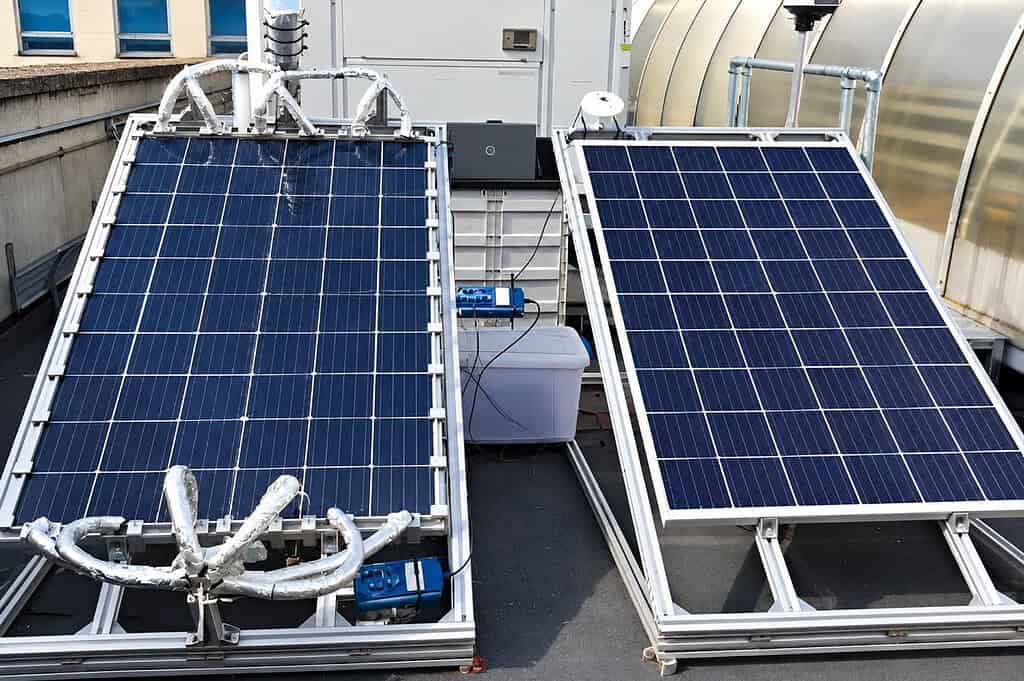
The system uses ten photovoltaic-thermal (PV/T) panels, which generate electricity while also collecting solar heat. Refrigerant pipework fitted behind the panels allows the heat pump to absorb this heat directly, rather than extracting it from outdoor air.
The researchers carried out 307 tests at the ENEA Casaccia Research Centre in Rome, assessing the system’s performance using the two heat sources under different operating conditions.
During solar operation, tests at an ambient temperature of approximately 22°C showed that heating capacity increased from 8.75kW to 10.6kW as solar irradiance rose from 322W/m² to 904W/m². This represented a 21.1% increase in heating capacity and an 18.7% improvement in COP between the two conditions.
The improvement was largely due to the higher refrigerant evaporation temperature achieved with greater solar input, allowing the heat pump to operate more efficiently.
However, the tests also showed that solar operation was not always the better option. When sunlight was limited, extracting heat directly from outdoor air could be more efficient.
The researchers then used the experimental results to model the system’s performance over a full year in seven international locations.
These simulations showed that selecting the more efficient heat source according to operating conditions could reduce annual electricity consumption by approximately 100–120kWh under the most favourable conditions, compared with air-source operation alone.
The study also found that electricity generated by the PV/T panels offered a greater economic benefit than the additional heat pump efficiency achieved through solar operation.
The findings demonstrate the potential benefits of combining solar collectors with CO₂ heat pumps, while highlighting that the efficiency improvements observed under favourable test conditions translate into relatively modest annual electricity savings.
The research was published in Applied Thermal Engineering.


