















UK – Hot water specialist Adveco explores the fundamental differences in heat pump DHW system design, key selection criteria and strategies for maximising performance and minimising the carbon footprint.
Heat pump technology is rapidly emerging as a critical component in the global shift towards sustainable energy, offering a highly efficient method for heating and cooling in buildings. However, the application of heat pumps to meet the rigorous and dynamic domestic hot water (DHW) demands of commercial buildings – such as hotels, hospitals, and large residential blocks – presents a complex design challenge. Simply installing a heat pump is insufficient; successful implementation requires optimising the system to strike a perfect balance between outlay costs, operational efficiency, and long-term environmental impact.
Commercial DHW systems are fundamentally categorised by their approach to heating and storage: Dynamic vs Storage systems. Understanding this dichotomy is the foundation for effective heat pump integration.
Dynamic water heaters: These systems are characterised by high heat input and low storage volume. They are engineered for rapid, continuous heating, ensuring the supply never goes cold, making them ideal for high-demand applications where space for storage is severely limited.
Storage water heaters: Conversely, these systems utilise a large storage volume with a comparatively small heat input. Their design philosophy is to dump stored hot water to meet demand and then gradually reheat the large volume over an extended period. This approach is highly effective for low-energy systems that prioritise high storage capacity to buffer demand spikes.
The choice between these two approaches significantly influences the size, cost, and complexity of the heat pump solution.
Key design considerations
When designing a commercial heat pump DHW system, the following factors must be meticulously evaluated: the initial capital investment for the heat pump units storage tanks, and associated electrical/plumbing infrastructure; the system’s operational efficiency (COP) which directly determines the long-term utility bills; the carbon emissions associated with the electricity used, which is directly tied to the system’s COP; noise and space requirements are also critical factors in urban environments, where heat pump siting must account for acoustic performance and physical footprint. The most important design decision is whether to utilise the heat pump for preheating only or for full water heating.
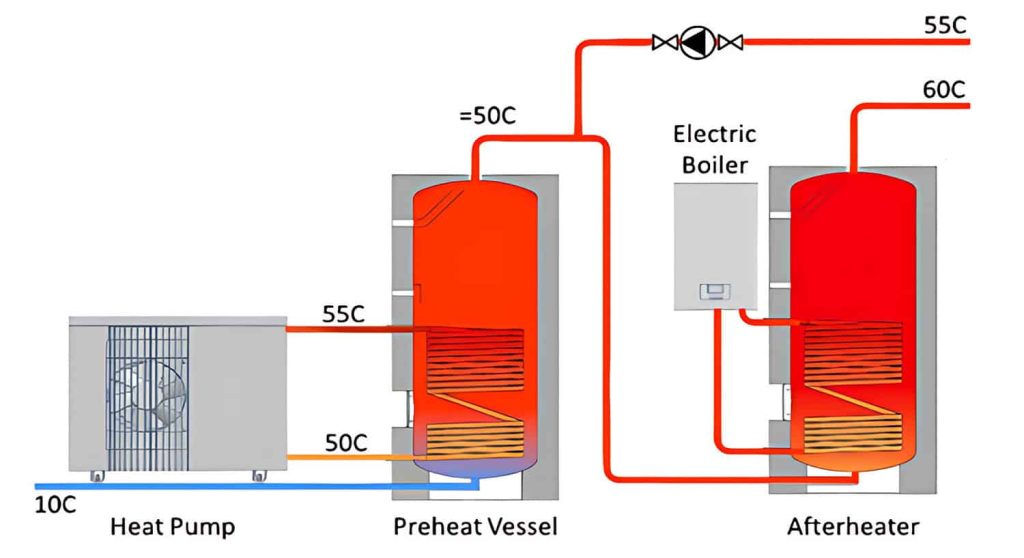
The heat pump preheat system is a strategy which employs a low-temperature air source heat pump (ASHP) to raise the water temperature to an intermediate level (e.g., 40°C). The secondary heat source (often a highly efficient electric after heater) provides the final temperature lift. The advantages of such systems are that although they require larger storage volumes, they allow for smaller, lower-cost heat pumps (eg, 23kW ASHP). They boast a higher overall system efficiency (with a COP often around 2.6) because the heat pump operates in its most efficient temperature range. They are best suited for peaked demand patterns with minimal background use. The disadvantage is that these systems do require more physical space for storage tanks.
Heat pump water heating systems utilising a high-temperature ASHP to directly heat the water to the required final temperature (eg, 60°C) will, however, require a smaller storage volume (eg, 1,000 litres). They are also suitable for buildings with continuous demand patterns, but, will require larger, more powerful heat pumps (eg, 90kW ASHP), leading to higher outlay costs. Operating at higher flow temperatures results in a slightly lower efficiency (COP often around 2.5). This comparison highlights a key trade-off between lower outlay costs and higher efficiency via preheat versus smaller space requirements via high-temperature direct heating.
Refrigerant choice is crucial, as it must balance performance, safety, and environmental impact. R32 is a common contemporary choice due to its medium Global Warming Potential (GWP) and low flammability.
However, emerging refrigerants, particularly R290 (propane), are gaining traction for high-temperature heat pumps. R290 offers superior thermal properties, making it highly suitable for higher flow temperature systems. The challenge lies in its flammability and associated safety concerns, which necessitate enhanced installation protocols and a highly trained workforce. Future trends indicate a definitive transition to hydrocarbons like R290 by the late 2020s/early 2030s as regulations tighten on high-GWP fluids.
Designing for maximum efficiency
System efficiency (COP) is dynamically influenced by the flow temperature and the ambient air temperature, often resulting in capacity reduction in cold weather.
Strategies to maximise annual efficiency and reliability include minimising ASHP size. Correctly sizing the heat pump reduces initial costs without compromising performance if paired with adequate storage. You can also design for the lowest possible flow temperature that still meets the system requirements, as lower temperatures equate to higher COP. Utilising the heat pump for preheating keeps it operating in its most efficient range, boosting the overall COP during the bulk heat-up cycle. Also critical is the inclusion of redundancy and simple controls to ensure system reliability and prevent operational errors.
Heat pump systems are low-carbon but not zero-carbon, as their environmental impact is directly linked to the efficiency (COP) and the grid’s carbon intensity. The Preheat System, with its higher overall COP, often proves to be the most cost-effective and environmentally friendly option, maximising the efficiency of the heat pump while utilising direct electric heating for a small, necessary temperature boost.
Heat pump systems represent a highly sustainable solution for commercial hot water needs. Success hinges on designers optimising the system by carefully balancing size, efficiency, and cost, recognising that preheat systems with low-energy, high-storage designs are frequently the superior choice. Future advancements in refrigerants, alongside necessary growth in workforce training, will continue to enhance the viability and performance of this critical technology.