


















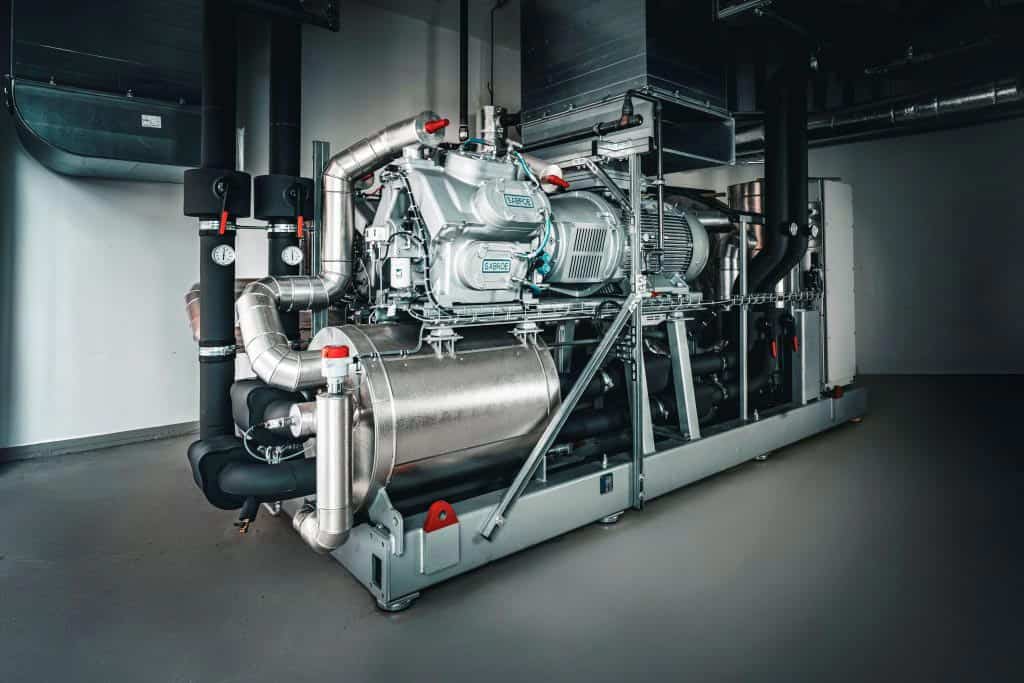
Germany’s 700kW Baltic Sea heat pump begins heat supply
Germany – A 700kW seawater heat pump is now supplying a district heat network in Neustadt in Holstein, Germany, using the Baltic Sea as its heat source.
The Johnson Controls Sabroe DualPAC feeds an approximately 2km network serving the city’s harbour district and raises the network water temperature to around 70°C. Stadtwerke Neustadt in Holstein inaugurated the installation on 4 September following several months of trial operation, describing it as Germany’s first seawater heat pump to feed a larger heat network.
Project consultant HIC Consulting says the system has sufficient capacity to supply more than 200 households.
Baltic Sea provides the heat source
Seawater is drawn from Neustädter Bucht through an intake station, where it is filtered and cleaned before being pumped to the energy centre.
A heat exchanger transfers energy from the seawater to a separate glycol circuit, keeping seawater out of the heat pump itself. The cooled water is then returned to the Baltic Sea.
The energy centre includes the heat exchanger, heat pump and a 25,000-litre buffer store before heat is distributed to connected residential, commercial and public buildings.
Two-stage ammonia heat pump
The installation uses a Johnson Controls Sabroe DualPAC, a two-stage industrial heat pump manufactured in Denmark.
The DualPAC uses R717 ammonia as its refrigerant and is designed for applications requiring relatively large temperature lifts, including heat networks.
Johnson Controls says the Neustadt system can provide up to 700kW of heat. During colder winter conditions, around 500kW can be extracted from the seawater, with electrical input used to lift the temperature to the level required by the network.
The seawater heat pump is an outstanding example of what is possible when courage to adopt new technologies, technical expertise and cooperation between many participants come together
Dr Mark Jahn, head of Stadtwerke Neustadt in Holstein
Part of wider energy system
The seawater heat pump forms part of a broader energy system for the harbour district rather than meeting the area’s complete peak demand on its own.
The wider system also incorporates recovered heat from a nearby waste-to-energy plant, thermal storage and additional generation for periods of higher demand.
Development of the scheme stretches back several years. A feasibility study supported through Germany’s Wärmenetze 4.0 programme was completed in 2019, followed by an application for funding through the National Climate Initiative in 2020.
The heat pump was delivered to Neustadt in December 2023, with the network and associated infrastructure subsequently brought into service.
Further expansion of the heat network is continuing during 2026 as additional sections of the harbour district are connected.


