











Thermal storage could halve heat pump operating costs and cut upfront investment by 29.7%
China – Thermal energy storage could halve the operating costs of an air-source heat pump system while also reducing the amount of heat-pump capacity required, according to new modelling of a large office building in China.
The study, by Tailu Li, Shuo Li, Xiaolong Liang and Jiapeng Wang and published in Elsevier journal Cleaner Energy Systems, modelled a six-storey, 10,030 m² office building in Tianjin. It compared a conventional air-source heat pump system with a configuration incorporating a 1,010 m³ stratified water store.
The researchers found that the storage-assisted system reduced annual operating costs from CNY 293,388 to CNY 141,958, a saving of around 51%. It also reduced the number of heat-pump units required from 11 to six, cutting initial system investment by 29.7%.
Storage shifts demand to cheaper electricity
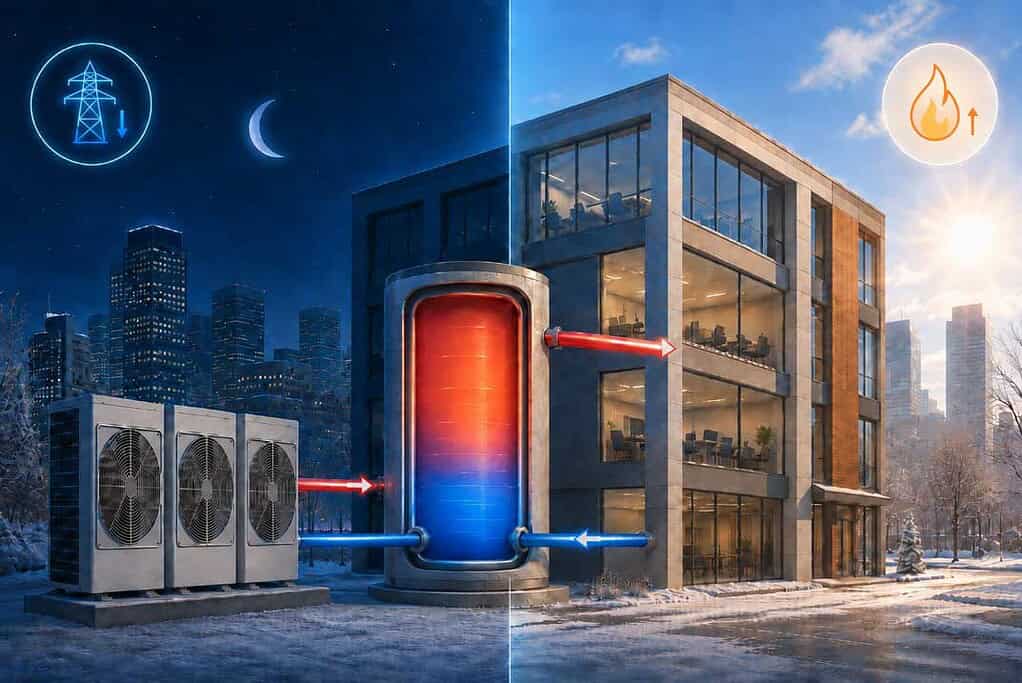
The proposed system uses thermal storage to separate the timing of heating or cooling generation from when the building requires it.
Rather than sizing the heat pumps around the building’s maximum instantaneous demand, the storage-assisted configuration is sized against cumulative daily energy demand.
The heat pumps primarily charge the water store between 23:00 and 07:00, when the electricity tariff used in the model is CNY 0.328/kWh. Stored hot or chilled water is then used during the building’s occupied daytime hours.
Peak electricity in the Tianjin tariff model costs CNY 1.132/kWh, making the timing of heat-pump operation a major factor in the calculated operating-cost reduction.
This system can effectively reduce peak grid load and achieve peak shaving and valley filling
Authors of the Cleaner Energy Systems study
Heat pump requirement falls from eleven units to six
The modelled building reached maximum heating and cooling loads of 831 kW and 1,307 kW, respectively.
A conventional system sized for peak instantaneous demand required 11 heat-pump units. With thermal storage enabling energy to be generated in advance, the researchers calculated that six 146 kW units would be sufficient.
Despite adding the 1,010 m³ storage tank, the calculated initial system cost fell from around CNY 3.43 million to CNY 2.41 million.
Over the 15-year assessment period, lifecycle costs were calculated to fall from CNY 5.66 million to CNY 3.49 million, a reduction of 38.37%.
The study also reports a dynamic payback period of approximately 3.57 years and an internal rate of return of 12.24%, based on a 10% benchmark discount rate.
Cooling gains offset winter penalty
Moving heat-pump operation into night-time hours produced different results between the heating and cooling seasons.
During winter, lower night-time temperatures and frosting reduced heat-pump efficiency. Heating-season electricity consumption increased by around 3% compared with the conventional system operating mainly during the day.
During summer, the effect was reversed. Lower night-time ambient temperatures improved heat rejection while the heat pumps could operate steadily at full load to charge the chilled-water store.
Cooling-season electricity consumption fell by 14.7%, from 181.3 MWh to 154.7 MWh.
The researchers calculated that the system could reduce annual carbon emissions by 8.8%, from 200 tonnes to 182.4 tonnes, and identified higher-density phase-change storage, on-site solar PV and model predictive control linked to real-time electricity pricing as areas for further study.
.


