















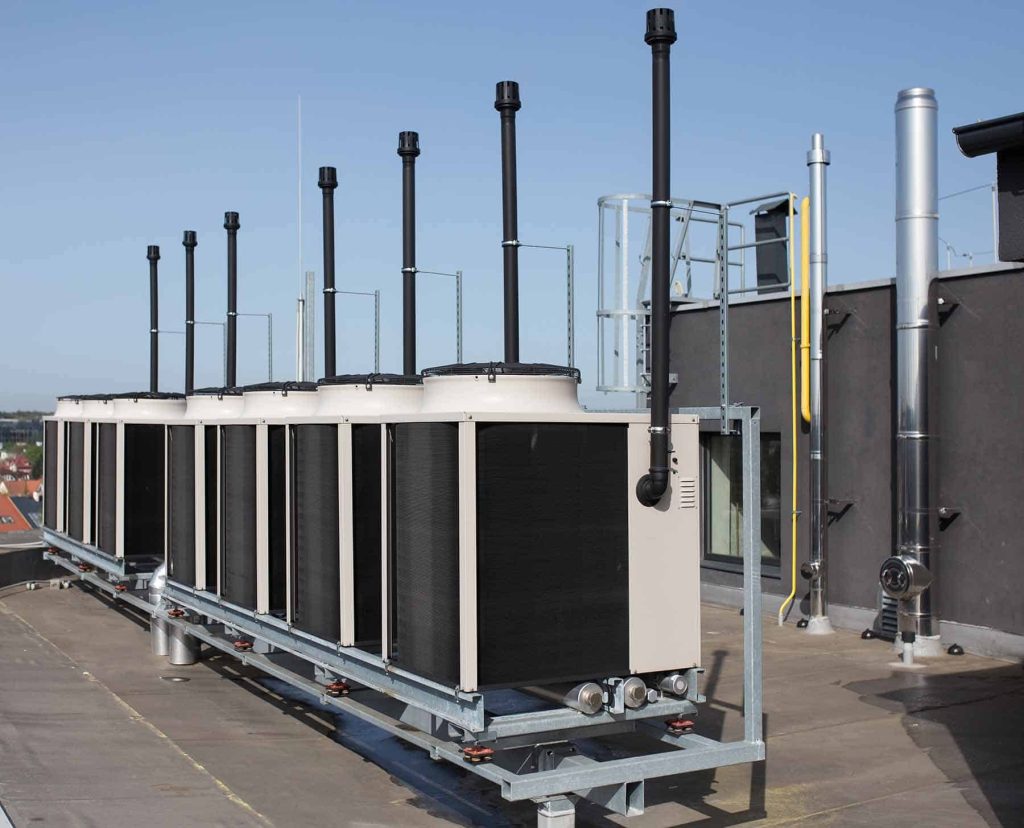
UK – Specialist heat pump provider Pure Thermal recently relaunched the commercial gas absorption heat pump range from Italian manufacturer Robur as its appointed UK partner. Garry Broadbent explains why the technology represents a significant opportunity.
Commercial gas absorption heat pumps (GAHPs) from Robur were widely applied throughout the UK up until 2014, with hundreds of units successfully operating nationally. However, during the period where the electrification of heat and fuel switching from gas became the industry priority, Robur Heat Pumps left the UK due to the increasing focus on electrically powered heat pumps and direct electric forms of heating.
But as we get nearer to 2050 a realisation has occurred. It is now clear that there is a need for more transitional measures to accelerate carbon reduction. This is where the application of commercial GAHPs has re-emerged with the potential to provide immediate carbon savings by simply reducing gas usage. These savings are achieved via heat pump technology, but without the need for increased electrical supplies.
Upgrading electrical supplies for retrofit commercial heat pump applications is costly and can be difficult to obtain due to regional or local electricity supply issues. We have 25 years until 2050 and it’s clear that a more transitional approach, rather than immediate fuel switching from gas, can really benefit some carbon reduction-focused applications. We would ask if GAHP technology has been overlooked, in favour of electric heat pumps, because gas is seen as something that must be removed rather than gas usage being reduced.
However, it’s clear that the situation can be viewed differently where GAHPs are able to provide a transitional heat pump opportunity with electrification to follow. This means that lower capital cost carbon reduction measures can be applied immediately via GAHPs and long delays/costs for new electrical supplies can be avoided.
What are the benefits?
GAHPs are relatively straightforward to apply as they use the incumbent/existing gas supply and use only 1kW of electricity to generate 40kW of heat. Consider that we have a commercial gas heater which is more than 100% efficient offering an immediate reduction in gas usage when compared to boilers.
Taking the mantra of using less gas rather no gas, the application of GAHPs can make real sense for applications that do not have cost effective or timely access to increase electrical supplies to install electrically powered heat pumps.
Considering Robur’s track record, the question of proven technology is answered by there being hundreds of GAHPs operating in the UK having been widely applied since 2004.
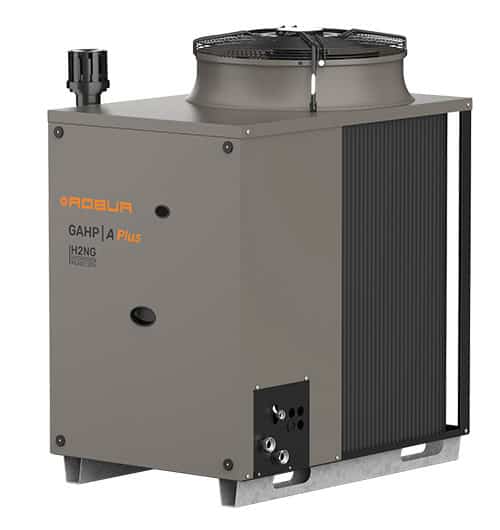
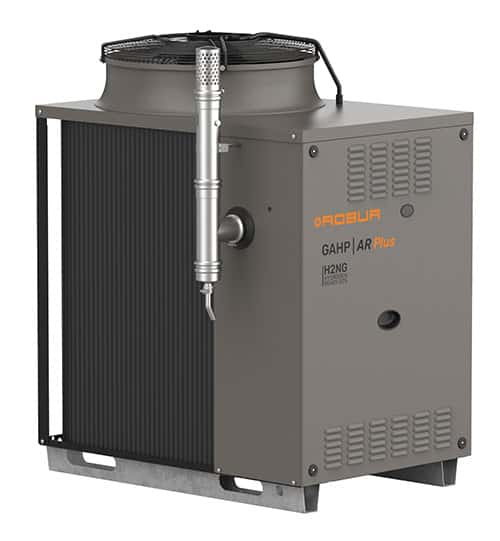
A modular approach is taken to specification utilising the Robur A-Plus 40kW unit in single or parallel unit configuration. There is also the option to specify factory assembled skids with multiple GAHP units mounted in a single system plus there is also the additional option to select a hybrid system with heat pumps and skid-mounted externally located boilers.
This option provides a complete hybrid solution by sizing the gas heat pumps to cover the maximum amount of carbon reductions and only bringing the gas boiler into play below an external temperature of, say, 5°C to provide additional capacity support.
With respect to current UK demands, the application team at Pure Thermal is confident that the configuration options and case studies within both the UK and throughout Europe will be able to demonstrate correct GAHP application methods to provide confidence to specifiers and designers.
It must be considered that this is not new technology; on the contrary this is extremely well-established technology with successful application going back over the last 20 years with GAHP simply being a different type of heat pump refrigeration system to the vapour compression refrigeration system found in an electric heat pump.
How do they work?
GAHP units utilise a burner to place heat into the refrigeration circuit unlike the electrical compressor which does the same job in a vapour compression system. However, both types utilise air source or ground/water source renewable energy.
GAHPs use gas to generate heat using renewable source energy, be it air or water, to provide a system that will use circa 40% less gas than the incumbent boiler. Hence, we have a heat pump system which is practical and easy to apply & integrate with existing gas supplies with an output temperature capability of 70°C.

There is no doubt that GAHP technology is proven and ready to be applied now for both new and retrofit applications.
Garry Broadbent, Pure Thermal
Product and application training is an important element of the Pure Thermal package and for GAHP we provide full training for designers and specifiers and contractors that are new to the concept.
Several webinars and training sessions are planned throughout Q1 and Q2 by Pure Thermal that will demonstrate that GAHPs are simply another type of heat pump powered by gas rather than electricity.
Transitional technology
The present unknown situation regarding the use of the gas in the future is still to be determined, with a consultation concerning the gas transition launched in November 2025. However, when considering the use of gas, it is noted that in Q4 of 2025 a significant investment of circa £150 million was placed by Government into making ready certain sections of the grid to take advantage of hydrogen to a mix of 5%.
Alongside this it should also be noted that biogas is gaining more momentum as is also the case in Spain and Italy with the objective of supplying the grid with clean renewable gas. This indicates that the application of GAHPs can be viewed as an immediate transitional carbon reducing technology for the next 15 years, until remedial improvements to the electricity grid ensure that power is more readily available to apply electric heat pumps.
Or it could be considered that GAHPs are a technology that could be viewed as long term to operate for many years with a gas grid circulating clean gas that could be a mix with a biomethane or hydrogen base.
Whichever view is taken, whether transition or longer term, there is no doubt that GAHP technology is proven and ready to be applied now for both new and retrofit applications.