










UK – Alpesh Trivedi, Director of Magnetic International UK (a subsidiary of Magnetic GmbH), compares chemical-free vs traditional dosing approaches to closed-loop water treatment.
Closed-loop heating and cooling systems are fundamental to modern building services and industrial energy infrastructure. From biomass and district heating networks to commercial HVAC systems, maintaining water quality is essential to ensure efficiency, reliability and asset longevity.
For decades, the industry has relied on chemical dosing regimes, typically involving inhibitors, biocides and dispersants, to manage corrosion, scale and biological activity. However, increasing attention is now being given to chemical-free approaches, which use physical processes to control contamination and stabilise system conditions.
Rather than being a simple “either-or” choice, the shift reflects a broader change in how water treatment is understood: from chemical correction to system conditioning and control.
The traditional approach: chemical dosing
Chemical water treatment has long been the default solution for closed-loop systems. By introducing corrosion inhibitors and scale preventatives into the circulating water, operators aim to create a protective chemical environment that limits degradation of system components.
This approach is well understood and widely supported by established standards such as BSRIA guidance documents (notably BG 29 and BG 50), as well as boiler manufacturer requirements. When correctly specified and maintained, chemical dosing can be effective in reducing corrosion rates and controlling mineral deposition.
However, the effectiveness of chemical treatment is highly dependent on consistent management. Dosing levels must be monitored, adjusted and replenished regularly. Under-dosing can lead to system deterioration, while over-dosing may introduce unnecessary cost or unintended chemical interactions.
In practice, many systems operate outside optimal chemical conditions due to:
- Inconsistent maintenance regimes
- Lack of monitoring
- System dilution through top-up water
- Operator variability
This creates a reliance not just on chemistry, but on ongoing human intervention.
The emerging approach: chemical-free treatment
Chemical-free water treatment takes a fundamentally different approach. Rather than modifying water chemistry through additives, it focuses on removing contaminants and influencing water chemistry within the system.
Typical elements include:
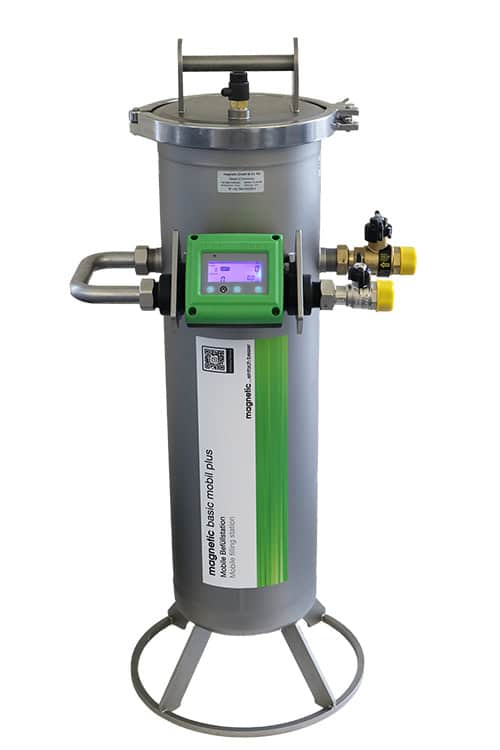
- High-efficiency physical filtration
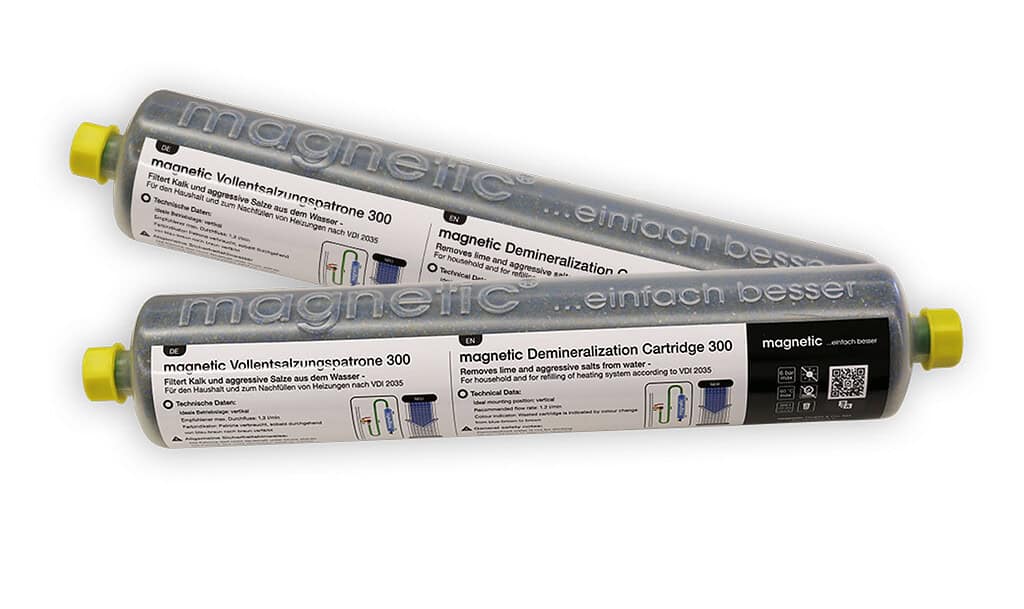
- Demineralisation as a controlled water treatment, and
- Ongoing monitoring
The objective is to control the root causes of fouling and corrosion, rather than continuously compensating for them.
One of the key advantages of this approach is its passive nature. Once installed, physical treatment systems operate continuously without the need for chemical replenishment or frequent adjustment. This reduces dependency on operator input and can lead to more stable long-term system conditions.
The term demineralised water originates from the everyday use, and it is argued that the correct technical term is deionised (desalinated) water, commonly referred to as demineralised water.
Deionised water is produced using a mixed-bed ion exchange resin, which removes both cations and anions, resulting in water with very low ionic content and low electrical conductivity.
Companies such as Magnetic GmbH have developed systems based on these principles, combining filtration, Demineralisation into integrated solutions for industrial and commercial heating systems.
Comparing the mindsets
The distinction between the two approaches is not only technical but also philosophical.
Intervention vs prevention
Chemical dosing is inherently reactive, compensating for contamination and corrosion through additives.
Chemical-free systems are more preventative, focusing on removing debris and limiting the conditions that lead to fouling.
Active management vs passive operation
Chemical treatment requires ongoing monitoring, dosing and compliance, while chemical-free systems are largely self-operating and low maintenance.
Complexity vs simplicity
Chemical regimes introduce operational complexity, including storage, handling and safety requirements.
Chemical-free approaches reduce these variables, offering a simpler long-term solution.
Performance visibility
Physical treatment provides a more visible and measurable impact, particularly through the removal of sludge and debris from the system.
Where each approach fits
Both approaches have a role depending on system requirements.
Chemical dosing remains appropriate where:
- Specific corrosion risks require chemical inhibition
- System design or standards mandate chemical treatment
- Water chemistry must be tightly controlled
Chemical-free solutions are particularly suited to:
- Systems with recurring sludge or magnetite issues
- Installations with limited maintenance access
- Operators seeking to reduce chemical handling
- Long-term asset protection strategies
A shift in industry thinking
As HVAC systems become more complex and performance expectations increase, the industry is moving toward more resilient and lower-maintenance solutions. The growing interest in chemical-free water treatment reflects this shift. By focusing on system cleanliness, stability and continuous physical control, these approaches align with broader goals around energy efficiency, sustainability and reduced operational risk.
For example, the upcoming BSRIA guide BG89 is the UK’s first comprehensive guide to chemical-free water management for closed systems. This represents a significant shift and provides an alternative approach for protection and maintenance of systems.
This guide will complement existing publications, including BG 29 (pre-commission cleaning) and BG 50 (water treatment), to provide a comprehensive framework for best practice.
For designers, installers and operators alike, the key lies in understanding how different treatment strategies can be applied effectively. Rather than viewing chemical and chemical-free methods as competing solutions, the emphasis is increasingly on selecting the right combination to support long-term system performance.